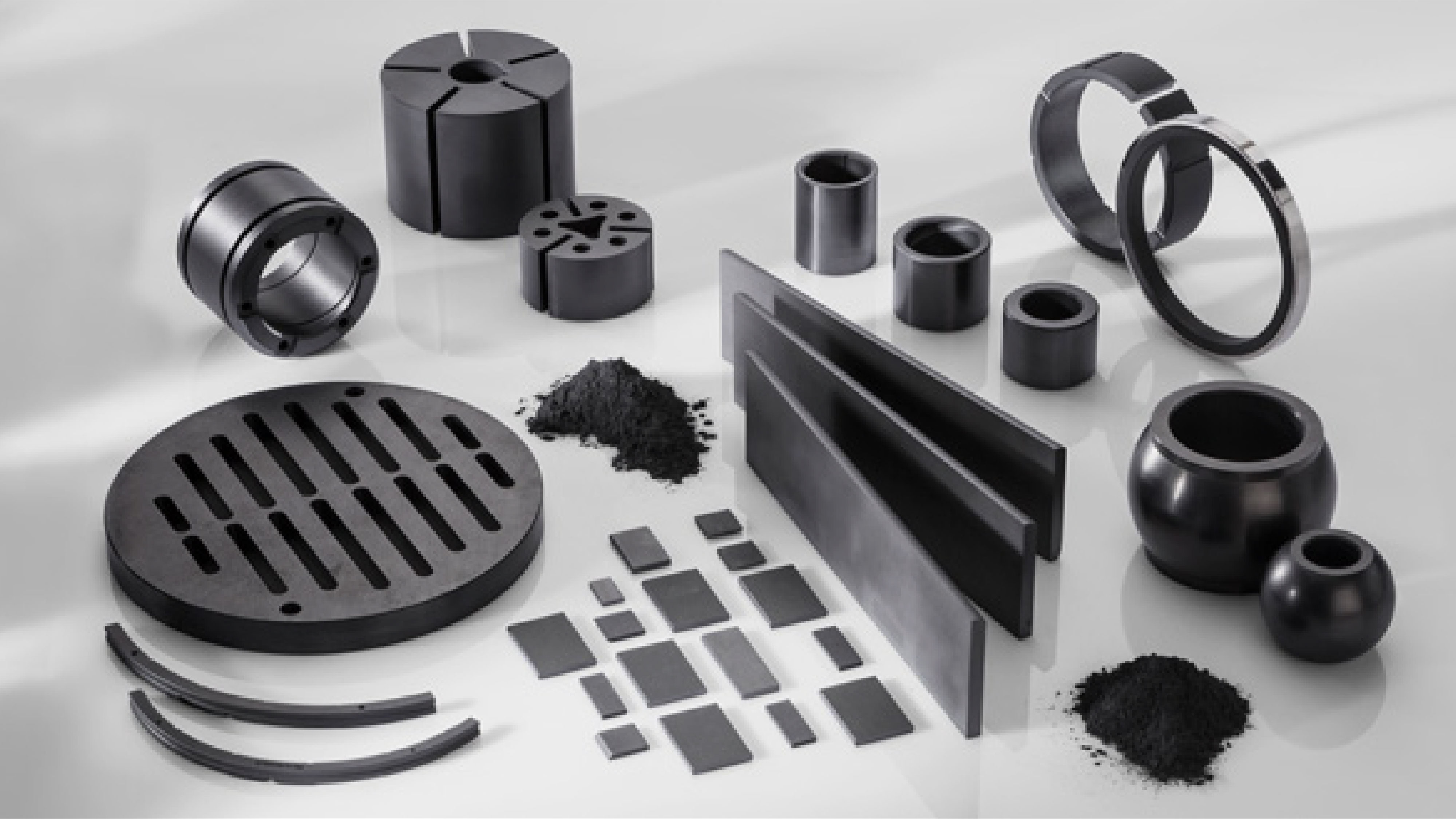

Product Introduction
1. Overview
Resin Bonded Carbon Graphite, also commonly referred to as molded graphite in the industry based on its mainstream molding process, is one of the most widely used low-cost engineeringmaterials among carbon-graphite composites. It uses natural or synthetic graphite powder as the core filler, leveraging the inherent self-lubricating and wear-resistant properties of graphite, paired with thermosetting resins(commonly phenolic resin, epoxy resin) as the bonding matrix. After mixing, compression/injection molding, it is cured at a low temperature of around 200°C to form thefinal product. Unlike traditional graphite materials that require high-temperature sintering andcoking, it eliminates the high-temperature coking step, featuring a short production cycle and low energy consumption, making it the lowest-cost carbon-graphite material for seals andbearings.As a customizable composite material, it can adapt to different working conditions by adjusting the type and ratio of resins, becoming an optimal solution that balances cost and performancein light-load, normal temperature civil and general industrial scenarios.

2. Core Performance ParametersThe performance of resin-bonded graphite is jointly determined by graphite filler and resinmatrix. The typical performance parameters of general industrial grades are as follows:

3. Core AdvantagesThe advantages of resin-bonded graphite are very clear, perfectly adapting to the needs of normal temperature and light-load scenarios:1. Ultimate Cost Advantage: With simple production process and no need for high temperature sintering, its cost is only 1/2 of that of high-end carbon-graphite materials,making it the optimal choice for low-cost scenarios, which can greatly reduce the materialcost of civil and general industrial products.2. Easy Mass Production of Complex Parts: It supports compression and injection molding, enabling low-cost mass production of parts with complex geometric shapes without subsequent complex machining, adapting to the needs of large-scale mass production.3. Excellent Sealing & Leakage Prevention Performance: Resin completely fills the pores of graphite, resulting in an extremely low overall open porosity. It has excellent anti-leakageability, perfectly adapting to the anti-leakage requirements of seals and pump components.4. Customizable Food-Grade Properties: By selecting FDA-certified food-grade resins, it can be made into materials that meet food contact standards, with no toxic small molecule precipitation, perfectly adapting to the hygiene requirements of the food and beverageindustry.5. Basic Self-Lubricating Capability: It retains the self-lubricating property of graphite, enabling low-friction operation under room-temperature working conditions, reducing theuse of external lubricants and making the operation cleaner.
4. Typical Application Scenarios Combined with its performance boundaries, the adaptation scenarios of resin-bonded graphite are very clear, and it can only be used in room-temperature and light-load working conditions.Typical applications include:
1. Food & Beverage Industry: Seal components for light-load water pumps, parts for beveragedispensers, low-load bearings for food processing equipment, balancing food-grade hygienerequirements and low-cost needs.2. Civil Pump & Valve Field: Seals and bearings for household submersible pumps and smallclean water pumps. The normal water environment and low-load working conditionsperfectly match its performance boundary, and the cost is far lower than high-end carbon materials. 3. General Mechanical Seals: General mechanical seal components for normal temperatureand low pressure, such as seal parts for small water pumps and valves, with excellent anti-leakage performance and low cost.4. Fluid-Immersed Bearings: Low-load bearings working in fluids such as oil and water. The fluid can take away friction heat, avoiding temperature exceeding 200°C, and the pore oilstorage feature can achieve long-term wear reduction. 5. Small Low-Pressure Vacuum Pumps: Vanes and bearings for small normal-temperature and low-pressure vacuum pumps, with low working temperature and load, adapting to itsperformance requirements.