
Product Introduction
Product Introduction
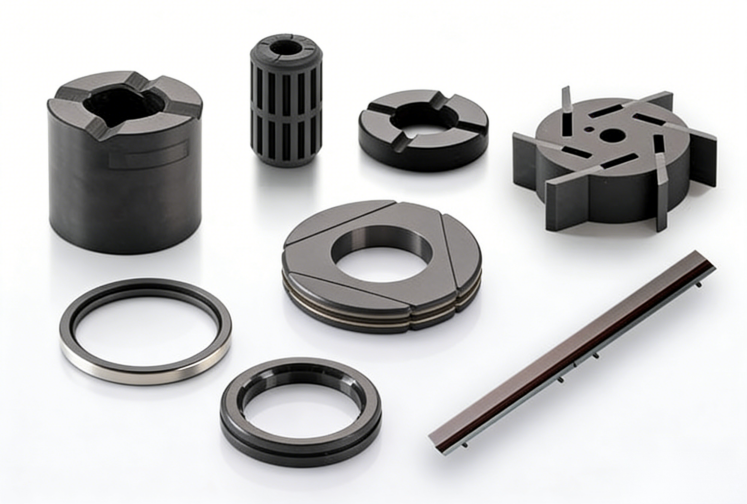
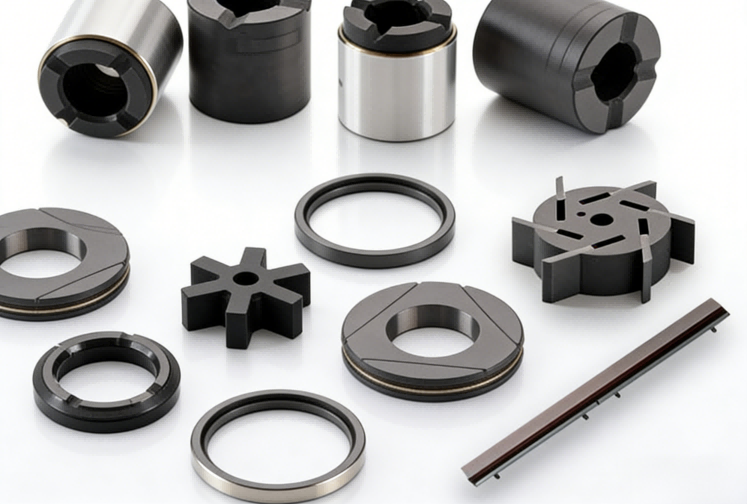
Impregnated graphite is a material that fills the open pores of graphite by vacuum pressure impregnation, filling resin, metal, PTFE and other impregnants into the porous graphite matrix, improving the compactness and strength of the material. It is the most widely used graphite sealing friction pair material.
Technical Parameters
Parameter | Specification |
Density | 1.8~2.2g/cm³ |
Shore Hardness | 50~70 HS |
Compressive Strength | 50~80MPa |
Porosity | <0.5% |
Performance Features & Core Advantages
- Good Compactness: The impregnant fills the pores of graphite, solves the penetration problem of pure graphite, and can adapt to high pressure and low viscosity media.
- Strength Improvement: After impregnation, the compressive strength is increased by more than 50% compared with pure graphite, and the anti-deformation ability is stronger.
- Retain Graphite's Self-lubrication: After impregnation, it still retains the self-lubrication characteristics of graphite, with low friction coefficient.
Advantages Over Similar Products
Compared with molded graphite, impregnated graphite has higher compactness and strength, can be used in high pressure and penetration risk working conditions, and has a wider application range. Compared with hard surface materials such as silicon carbide, impregnated graphite is a soft material. When paired with hard surface rings, the running-in is faster and the centering performance is better, suitable for working conditions with slight offset load. However, its temperature resistance upper limit is lower than that of pure graphite, because the impregnant has a decomposition temperature.
Main Application Scenarios
- Pump Mechanical Seal: Static seal ring for chemical pumps and water pumps
- Valve Seal: Stem seal and seat seal for high temperature and high pressure valves
- Compressor Seal: Piston rings and packing rings for gas compressors